


CHVALETICE MANGANESE PROJECT
PROJECT OVERVIEW

Located approximately 90 km east of Prague in the Czech Republic, the Chvaletice Manganese Project entails re-processing a significant manganese deposit contained in waste (tailings) from a decommissioned mine that operated between 1951 and 1975.
The Chvaletice resource is the only sizeable, classified resource of manganese in Europe.
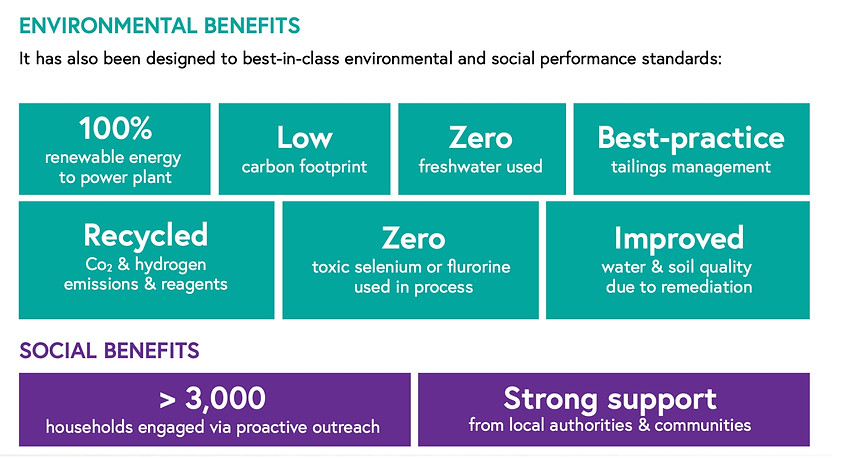
Chvaletice is not a mining project. It is a unique and innovative waste recycling initiative that avoids the negative impacts of traditional hard rock mining. As the project recycles historic mine tailings, it will clean up the contaminated site and eliminate a longstanding source of water pollution. Over the 25-year life of the Project, remediation and reclamation work will be conducted to bring the entire Chvaletice site into compliance with the Czech Republic’s environmental regulations and standards.
As a source of an important critical raw material, the Project is well positioned to support secure, responsible and diversified supply chains for allied technology, defence and battery industries. The Project has the potential to strengthen allied supply chains by providing up to 20% of projected 2030 European demand for high-purity manganese and supporting North American supply diversification in a market currently 100% reliant on imports for manganese.
Commercial development of the Chvaletice resource is expected to create approximately 400 full-time jobs, numerous commercial opportunities for Czech businesses, as well as substantial fiscal revenues for the Czech State and local communities.
Since 2015, during the evaluation and planning phase of the Project, Mangan Chvaletice has proactively and widely engaged with local authorities and community members. The company has benefited from their valuable feedback to refine and improve the Project design and development plan, with the goal of successfully integrating it into the local environment and life of the community.


DELIVERING WIDE-RANGING BENEFITS FOR ALL STAKEHOLDERS

“On May 14, 2026, Euro Manganese announced results from a new Preliminary Economic Assessment (PEA) for the Chvaletice Manganese Project. A new NI 43-101 technical report supporting the PEA will be filed within 45 days of the PEA news release. The PEA is the company’s current technical study, and the website will be updated shortly . Investors should refer to the May 14, 2026 PEA news release for the Company’s current project outlook”
PEA SUMMARY AND ECONOMIC ANALYSIS
On May 14, 2026, Euro Manganese announced the results of PEA for the Chvaletice Manganese Project. Read the full news release here.
On June 29, 2026, Euro Manganese announced the filing of the NI 43-101 and JORC Code technical reports. Read the full news release here.
The PEA was completed by Tetra Tech Canada Inc. (“Tetra Tech”). A NI 43-101 technical report on the PEA is filed under the Company’s profile on SEDAR+ and available on the Company’s website. A JORC report is lodged with the Australian Securities Exchange (“ASX”).
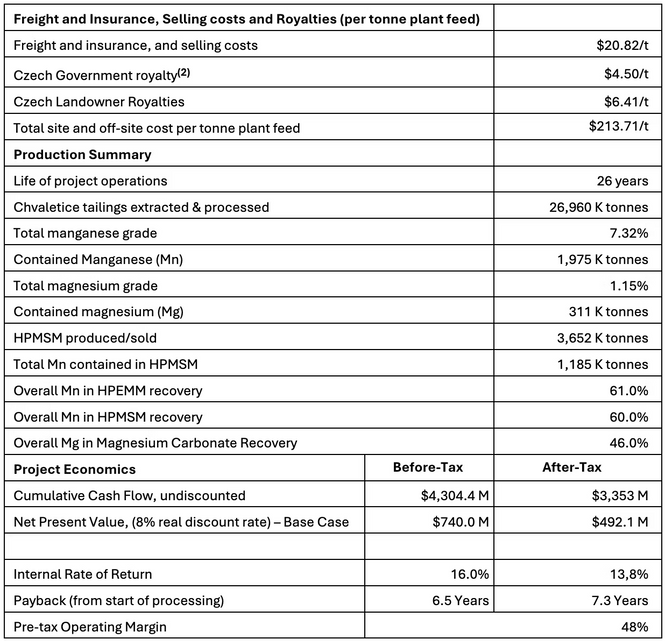
The following summarizes the material assumptions used in, and the results of, the PEA, assuming a targeted start of production in 2032.
Table 1: Economic and Operations Summary (M = Millions, K = Thousands)

Notes:
-
Average real selling prices per tonne of HPMSM (MnSO4·H2O, >32% Mn) are based on the market study prepared for the Company by Marketeye.org, entitled High-Purity Manganese Market Report dated April 20, 2026. The economic model uses forecast real prices, in 2025 dollars, of US$$2,653/t in 2032, US$2,776/t in 2033, US$2,827/t in 2034, and US$2,906/t in 2035, with the 2035 price held constant from 2036 through 2056.
-
Czech government royalty is 2,308 Czech Koruna (CZK) per tonne of Mn produced, translated to USD at a projected CZK to USD exchange rate of 22.57.
-
All the costs shown in the News Release are in US dollar
Table 2: Total Life of Project Revenue, Costs and Cash Flows
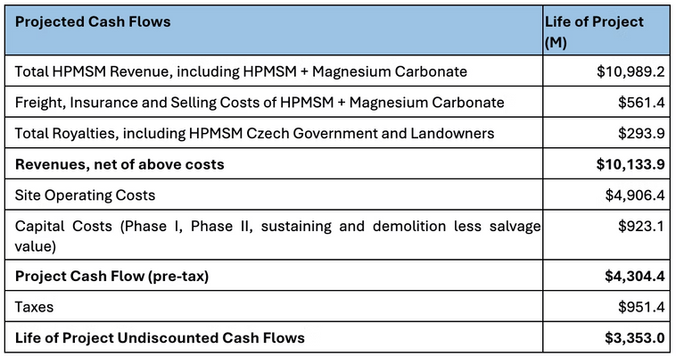
The Czech corporate income tax rate is 21%. In addition to the royalty of CZK 2,308 per tonne of unit Mn produced, the Czech Republic has various payroll and other taxes to generate revenue.
The Company has modeled the economics of this project conservatively from a tax perspective, with a full tax burden, based on Czech legislated tax rates.
Investment incentives exist in the Czech Republic and the European Union for certain, qualified investments, including investment tax credits, grants, and accelerated depreciation.
The Company is actively pursuing these non-dilutive funding opportunities, including investment tax credits, grants, and accelerated depreciation available under both Czech and EU frameworks.
Sensitivity Analysis
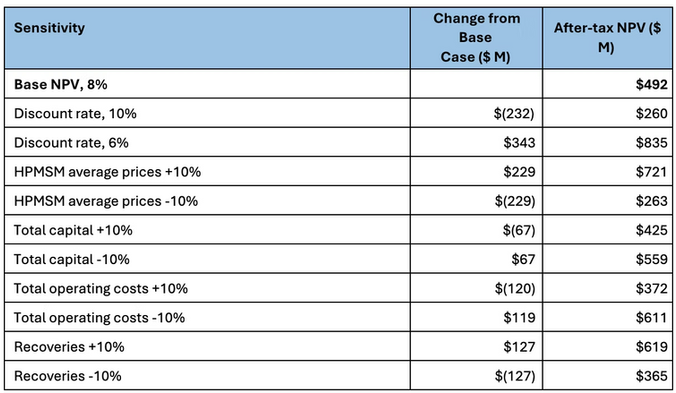
A sensitivity analysis for the Chvaletice Manganese Project was carried out to determine the effects of key variables in relation to the post-tax NPV of $492 million at a real discount rate of 8%. The results of the sensitivity analysis are presented in Table 3 below.
Table 3: Project Sensitivity Analysis
Initial and Sustaining Capital Estimates
Capital expenditure estimates have been prepared for both initial and sustaining capital. A projected summary timeline of scheduled capital costs is shown in Table 4.
Table 4: Initial Capital (Phase I), Plant Expansion (Phase II) and Sustaining Capital Schedule.
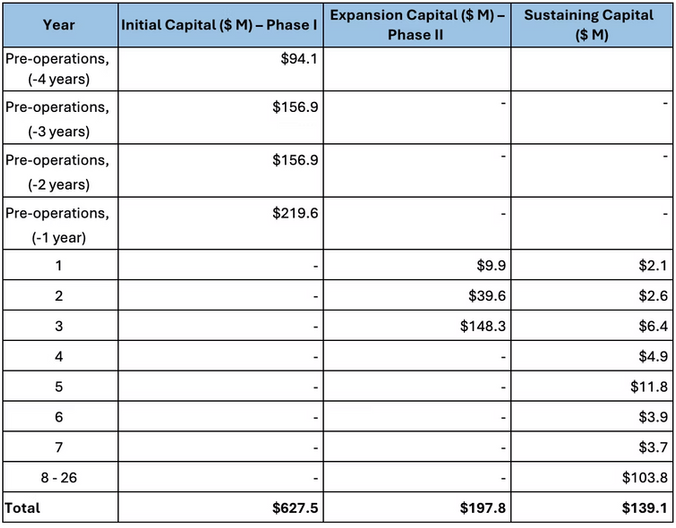
The expected initial capital expenditures (Table 4) for the Project, inclusive of capitalized operating startup costs, as estimated by Tetra Tech, as of Q1, 2026, are $627.5 million, including all development-related costs that will be incurred prior to the envisaged commencement of commercial operations. Capital costs incurred after startup are assigned to sustaining capital and are projected to be paid out of operating cash-flows (also see Table 5). Contingencies on initial capital expenditure have been added at appropriate percentages to each component of the Project, excluding capitalized operating costs, resulting in an overall contingency of $66.7 million or 15.5% of direct costs.
The Project site is served by excellent existing infrastructure, including rail, highway, a gas pipeline, and water and is adjacent to an operating power plant. The proposed plant site is zoned for industrial use and is the site of the former process plant that produced the Chvaletice tailings.
New and refurbished infrastructure that will be built to service the Project include a tailings excavation and handling facility: a south and north site connection utility bridge for transporting tailings slurry, return water pipes and the tube conveyor that returns a mixture of non-magnetic tailings and washed leach residue to the residue dry stacking area; a magnetic separation beneficiation plant; enclosed and winterized process plant buildings and various reagent storage facilities and product warehouse; an upgraded rail spur system with related loading/unloading facilities; an internal road network; an incoming electrical 400kV high voltage grid connection including rectifiers, transformers, GIS switchgear, and local distribution step-down transformers; a process equipment maintenance workshop; a mobile fleet maintenance workshop; spare part and maintenance supply warehouses; a comprehensive water management system, onsite laboratories; and general administrative offices.
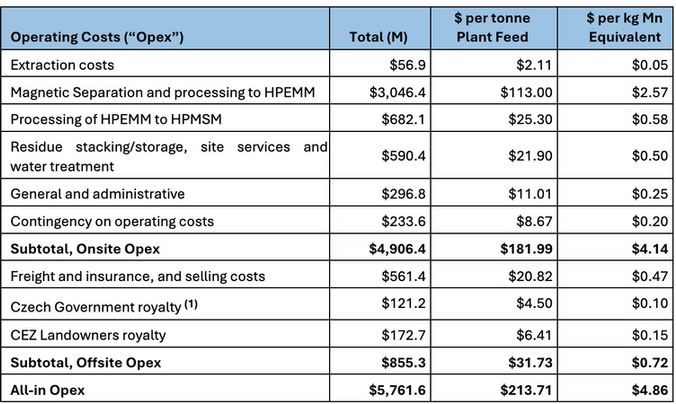
Operating Cost Estimate
Onsite operating costs are expected to average $181.99 per tonne plant feed ($4.14 per kg Mn equivalent) with offsite operating costs estimated to average $31.73 per tonne plant feed ($0.72 per kg Mn equivalent), as shown in Table 5.
Table 5: Life of Project Operating Costs
Notes:
-
Czech government royalty is 2,308 Czech Koruna (CZK) per tonne of Mn extracted, translated to USD at a projected CZK to USD exchange rate of 22.57.
-
Totals may not add exactly due to rounding.
PROCESSING FACILITIES DESCRIPTION
Tailings Extraction, Residue Storage Facility and Reclamation
In the tailings extraction plan, the three tailings cells will be excavated in a counterclockwise sequence, starting with Cell #3, followed by Cells #1 and #2. Tailings will be extracted using shovel excavators and hauled by truck to an intermediate re-pulping and a covered storage station located between Cells #1 and #2. The storage station will create a 5-day material stockpile. Re-pulped tailings will be fed to the magnetic separation plant via a slurry pipeline on a continuous basis.
A filtered blend of non-magnetic tailings and washed leach residue materials from the process plant will be conveyed using a tube conveyor to the storage station and placed and compacted in the Residue Storage Facility (RSF). The excavated area exposed after extraction of the existing tailings will be lined with a geomembrane liner. The RSF will be constructed in stages to suit residue storage requirements and progressively covered to limit the footprint of residue exposed to the air at any given time.
RSF design features include a geomembrane lined bottom, perimeter surface water diversion and a contact water collection system that is integrated with the overall site water management system. Dust management includes the implementation of modern dust suppression methods on open faces, interim stack surfaces and haul roads, as required.
Progressive reclamation will be undertaken as an integrated part of the residue stacking procedure. The filtered residue cover will consist of a low permeability soil and/or geomembrane cover to inhibit erosion and infiltration, and a growth layer to support vegetation growth.
The site is expected to be fully reclaimed and brought back into a productive community to be established in consultation with local communities, regulators and national government agencies. The RSF will be monitored during the post-closure period for geotechnical and environmental performance.
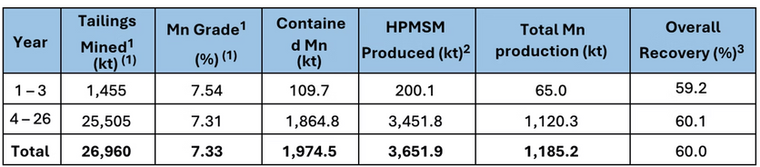
Table 7: PEA Tailings Extraction, Processing and Production Plan by Year
Notes:
1 Tonnage and grade in Table 7 were calculated by Tetra Tech and include an overall 0.5% manganese loss factor and no dilution.
2 All the annual HPEMM production is converted to HPMSM on site.
3 The combined overall recovery of manganese from tailings to high purity manganese products is estimated to be 60.0% over the life of the Project.
High Purity Manganese Products Production Facility
The processing facilities, including ancillary facilities, for HPMSM production from the CMP tailings were designed by Beijing General Research Institute for Mining (“BGRIMM”) together with EMN and Tetra Tech, based on the comprehensive metallurgical test results conducted during the previous PEA and validated through bench scale tests during the feasibility study. Additional metallurgical tests to recover manganese from anode slimes from electrowinning circuit were also conducted to support this PEA.
The study was based on the design work completed for the 2022 Feasibility Study which included process circuit and process equipment optimization. Key equipment items were sized and selected based on the FS design by upgrading HPMSM circuit from the nominal capacity of 100,000 t/a to 150,000 t/a. In addition, two additional circuits, one for manganese recovery from anode slimes produced from the electrowinning circuit using reductive leaching and one for sodium and potassium removal from the HPMSM crystallization circuit by incorporating a high-temperature crystallization bypass system. One additional circuit to convert the magnesium carbonate from waste to a saleable by-product is incorporated into the magnesium removal circuit.
The CMP process plant has been designed for a nominal nameplate production capacity of 150,000 tonnes per annum of HPMSM by processing approximately 1.1 million tonnes of the historical tailings per year.
HPMSM is produced by converting HPEMM flakes produced by electrowinning process without the use of selenium and chromium. This product is expected to best meet the high purity manganese market demand anticipated in current and future battery formulations.
The CMP HPMSM product is designed to contain no less than 99.9% high purity manganese sulfate monohydrate and a minimum of 32.34% manganese and will be sold in powder form, produced without the use of fluorine.
The dried HPMSM powder product will be packed prior to being shipped in trucks or containers to customers .
The process includes following unit circuits:
-
High-intensity wet magnetic separation circuit, upgrading the excavated tailings manganese grade to approximately 15% tMn for acid leaching.
-
Magnetic concentrate sulfuric acid leaching, neutralization to remove impurities and solid-liquid separation.
-
Pregnant leach solution deep purification to further remove heavy metals.
-
Manganese electrowinning to produce high purity HPEMM (high-purity electrolytic manganese metal) flakes using a selenium free process.
-
A magnesium removal process circuit to ensure efficient electrowinning operations and high-quality product and magnesium carbonate produced as a by-product.
-
HPEMM dissolution, solution purification and HPMSM crystallization and drying to produce battery-grade HPMSM for sale.
-
Other supporting circuits, such as ammonium recovery system, water management systems, steam generation. The proposed process flow sheet is illustrated in Figure 1 below.
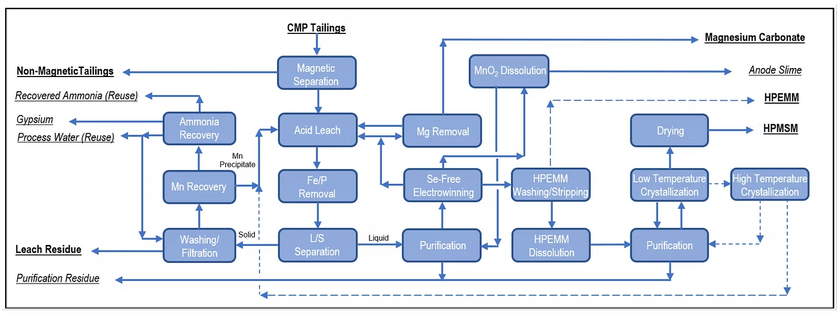
Figure 1: Updated Simplified Process Flowsheet
ENVIRONMENTAL IMPACTS, PERMITTING AND COMMUNITY ENGAGEMENT
Environmental impacts are monitored over the long term as part of the project. The ESIA process was conducted in two phases, supplemented by several expert studies and on-site monitoring. The result of the ESIA process, which involved participation from relevant authorities and the public, is the positive Environmental and Social Binding Statement, which was issued by the Ministry of Environment in March 2024. The ESIA permit is a crucial permit demonstrating that the assessed impacts on individual environmental components and the social sphere are acceptable and that the project is feasible.
The assessment results show that the implementation of the project will not worsen existing environmental conditions and will not have negative social impacts. Furthermore, the realization of the project will reduce the identified contamination of groundwater and surface water in the tailings and its vicinity, where the source of the pollution is demonstrably deposited material. As the deposit is of anthropogenic origin and the mined material is a waste-product, this constitutes the reuse or recycling of waste, aligning with the principles of the circular economy. The aim of remediation and reclamation is to create a near-natural area with high biodiversity and stability, which will be used for recreational and sports activities.
The ESIA process is followed by a subsequent permitting process when a significant portion of the permits had already been obtained, such as the Permit for the location of the processing plant, the Permit for the location of the rail spur, Product registration under the EU’s REACH Regulation, and other permits related to auxiliary activities (utility relocations, grid connection, and others). Another key permit is the Determination of the Mining Lease Permit, which was granted to MANGAN Chvaletice, s.r.o on January 23, 2025; this is another crucial permit which authorizes the company to conduct mining activities. In the following steps, the company will undergo the permitting process stipulated by the Building Act, followed by the final operating permit.
In 2026, the Company will continue to advance the permitting process under the Building Act, targeting completion of the final operating permit pathway in line with the feasibility study timeline. Each permitting milestone achieved further reduces Project risk and reinforces the Company's readiness to move into the next phase of development.
Key Highlights of the Social Commitment:
Significant Economic Catalyst: The Project will act as a primary economic driver in the Pardubice Region, creating 800–1,000 jobs during construction and providing stable, long-term employment for approximately 400 direct staff during operations, with a strong 85% local hiring commitment.
Commitment to Transparency: The Project has established a robust engagement framework, including a dedicated public information center in Chvaletice and dedicated digital platforms (project-specific website and online grievance tools).
Validated Social Acceptance: On March 27, 2024, the Czech Ministry of the Environment issued a favorable binding ESIA opinion, confirming that the Project meets the highest environmental and social standards. The Project currently faces no material barriers to acceptance, reflecting a strong Social License to Operate.
BENEFITS OF PEA AND NEXT STEPS
The PEA enabled the Company to optimize inputs based on current pricing, establishing the possibility for a two-stage construction strategy. This phased approach has the potential to allow for further optimization in phase two, lower upfront capital requirements, and enhance project economics by aligning investment with cash flow. The Company plans to explore this and other avenues to advance the Chvaletice Manganese Project further towards feasibility study, with targeted completion in H1 2027.
The Company will also continue to monitor high purity manganese markets and strategic sectors to which it contributes, including energy transition, grid-scale energy storage, e-mobility and aerospace and defence technologies. The Company will continue to engage with potential customers to secure additional offtake term sheets, pursue offtake agreements, and continue product testing.
In addition, during 2026, the Company is focused on the following key priorities to position the Project for its next development phase by:
-
Advancing the financing strategy by securing funding for Project priorities and progressing strategic financing discussions with potential partners;
-
Completing the acquisition of, or access to, the remaining land surface rights required for full Project development;
-
Strengthening the Project's regulatory foundation through the continuous advancement of permitting, further reducing development risk and demonstrating Project readiness; and
-
Maximizing non-dilutive capital by actively pursuing grants and incentives available from the EU and the Czech state
NI43:101 - Mineral Resource Estimate
Resource Estimate
Tetra Tech was engaged to oversee the planning and execution of sampling and assaying, to prepare the updated Resource Estimate for EMN's Chvaletice Manganese Project, to prepare the Technical Report in accordance with National Instrument 43-101 - Standards and Disclosures for Mineral Projects, and to prepare the independent JORC Code technical report in accordance with the Joint Ore Reserves Committee Australasian Code for Reporting of Exploration Results, Mineral Resources and Ore Reserves 2012 Edition (“JORC Code”). The 43-101 Technical Report, entitled “Technical Report and Mineral Resource Estimate for the Chvaletice Manganese Project, Chvaletice, Czech Republic”, with an effective date of December 8, 2018 (“the Mineral Resource Estimate”), was filed on SEDAR on January 28, 2019. The corresponding JORC Code technical report with an effective date of December 8, 2018, was lodged on the ASX on February 6, 2019.
No additional drilling or data collection pertaining to the technical disclosure of mineral inventory has been undertaken since the completion of the Mineral Resource Estimate, and the effective date for Mineral Resource Estimate is revised to April 27, 2026.
The Project's combined Measured and Indicated Resources now amount to 26,960,000 tonnes, grading 7.33% total manganese (tMn) and 5.86% soluble manganese (sMn), as detailed in Table 6 below.
Table 6: Chvaletice Mineral Resource Statement, Effective April 27, 2026

Notes:
-
Estimated in accordance with the Canadian Institution of Mining, Metallurgy and Petroleum ("CIM") Definition Standards on Mineral Resources and Mineral Reserves adopted by CIM Council May 19, 2014, as amended, which are materially identical to JORC Code.
-
The Mineral Resource has been classified as Indicated and Measured Resources based on the level of confidence in the deposit and estimation. Indicated Resources have lower confidence than Measured Resources. Mineral Resources do not have demonstrated economic viability and no Mineral Reserves have been defined for the CMP.
-
The Chvaletice Mineral Resource is a reasonable prospect for eventual economic extraction. The Mineral Resource has been estimated with Mn as the primary commodity and Mg as a by-product. A break-even grade of 3.78% total Mn has been estimated for the Chvaletice deposit based on preliminary pre-concentration, leaching and refining operating cost estimates of US$124.93/t feed, total recovery to HPEMM and HPMSM of approximately 46.3% and 44.9%, respectively, and a commodity price of USD $2.75/kg for HPMSM for the resource estimates. MgCO3 is produced as a raw product in the processing of HPMSM and would otherwise be discarded. This by-product is presented as total in situ concentration and has been assessed as being a reasonable prospect for eventual economic extraction based on preliminary and approximate estimated market value for MgCO3 of USD $800/t, process recovery of 45%, and an additional treatment cost of USD $1.00/t feed. The actual commodity price and recovery for these products may vary.
-
A cut-off grade has not been applied to the block model. The estimated breakeven cut-off grade falls below the grade of most of the blocks (excluding 46,613 t which have grades less than 3.78% tMn). It is assumed that material segregation will not be possible during mining due to inherent difficulty of grade control and selective mining for this deposit type.
-
Grade capping has not been applied.
-
Numbers may not add exactly due to rounding.
Land Acquisition – history and current status
Property Overview / Area of EMN / Mangan Chvaletice interest
During the preparation of the project, the area of land of interest for the implementation of the project was identified. No forced land acquisition or resettlement is required for the Project. The land can be divided into two parts. The first is "industrial zone" and the second is "tailing area/protected deposit area". Both integral areas are shown in Figure 1.

Figure 1 - Map of Project Land of Interest
-
“Industrial zone” - proposed site of the Processing Plant, ~25 ha – bottom part of the picture.
-
“Tailings area/protected deposit area”, ~1km square – top part of picture.
-
Both areas will be connected by a technological bridge for transporting the pulped raw material (tailings) and non-magnetic tailings residue and leach residue. Areas are divided by railway (national corridor) and public road.
Processing Plant Area
“Industrial zone” for processing plant fully contractually secured including connection to the railway shunting yard of the power plant.
-
Land (blue highlighting) of the industrial area is owned by Mangan Chvaletice, s.r.o.. This land was gradually purchased from the three original owners. The largest part was acquired in December 2023 through the acquisition of the site owner, EP Chvaletice. The acquisition/option agreements (share acquisition of 100 % of EP Chvaletice s.r.o.) were signed in 2018. Land on the northern part of the industrial zone (purchased from power plant company SevEn) allows connection to the power plant shunting yard and consequently the connection to the public railway.
-
Land of Správa nemovitostí Kirchdorfer CZ s.r.o. (green highlighting) to be acquired by the end of 2025. The acquisition contracts (asset deal on the land) were signed in 2020 and are in the notary's custody. Payments are made according to an agreed schedule. Acceleration of the contract is possible if required, depending on the timing of the payment.
-
Land of Galmet trade, spol. s r.o. (yellow highlighting) has been secured by a 30-year lease agreement since 2019; the lease can be converted to a sale of the leased land against the payment of an agreed purchase price.
Tailings Area/Protected Deposit Area
The tailings area as a Protected Deposit Area is designated for mining use. MANGAN Chvaletice, s.r.o. has concluded four out of five land access agreements covering 85% of the resource within the tailings, with the remaining land access agreement under negotiation.
-
Land of the Town of Chvaletice for the mining area (red highlighting) secured by 40- year lease agreement, entered into in 2022.
-
Land of CEZ, a.s. for the mining area (light blue highlighting) secured by a royaltybased lease agreement, signed in 2023.
-
Land of HELOT, spol. s.r.o. (green highlighting) and land of Mr. Vanek (mauve highlighting – but only a strip within protected deposit area) for ancillary land and start of the RSF construction areas is owned by Mangan Chvaletice, s.r.o. since January 2024.
-
Land of Municipality of Trnávka (light yellow highlighting) secured by the purchase agreement from 2019. Contract is in the notary's custody with ownership transfer onto Mangan Chvaletice upon the last payment when the construction permit is granted.
-
Land of Elektrárna Chvaletice a.s. (Sev.en Group) for the mining area (dark yellow highlighting) negotiations still ongoing, completion expected in 2024.
-
Land of BAUSET CZ, a.s. for access to the mining area (purple highlighting), publicly available purpose-built road, access granted; nevertheless, purchase considered in 2024/25 to simplify construction of the technological bridge (land outside of the tailing area).
HISTORY
The presence of manganese and iron minerals was first recorded near the present-day village of Chvaletice in the 1800s, and sporadic, localized mining of the Chvaletice ore body took place during the early 1900s. Starting in the 1930s, ore was processed for the recovery of manganese and shipped by rail to steel mills in Czechoslovakia and Germany. Between 1951 and 1975, the focus turned to the extraction of pyrite, which was used to produce sulfuric acid for various industrial clients. The waste from these operations created the three existing tailings piles that form the Chvaletice deposit. The piles were rehabilitated with a layer of topsoil and trees planted between 1975 and 1983.
In the late 1980s, Bateria Slany - a Czechoslovakian state-owned battery producer - undertook extensive studies of the tailings to determine the feasibility of producing manganese dioxide for the production of dry cell batteries. Although Bateria Slany confirmed the presence of a significant and economically attractive manganese carbonate resource, it halted development following the political regime change that was initiated in 1989, which brought about the end of communism in Czechoslovakia and the establishment of an independent Czech Republic. The deposit lay dormant until its mineral rights were granted in September 2014 to a Czech group of companies. The rights to the Project were then consolidated to form a jointly-owned holding company, Mangan Chvaletice s.r.o.
In May 2016, Euro Manganese Inc. acquired 100% of Mangan Chvaletice s.r.o., the Czech company that holds the exploration rights to the Chvaletice manganese deposit.


EVALUATION, PLANNING AND PATH FORWARD
EMN initiated its investigations on the Chvaletice Manganese Project in 2015. Early work conducted during 2015 and 2016 was focused on:
-
confirming the results of earlier exploration, metallurgical and engineering studies conducted by a Czechoslovakian State-owned company in the 1980s
-
determining the manganese content and mineralogy of the Chvaletice tailings
-
conducting legal and environmental due diligence investigations
-
conducting exploratory beneficiation, leaching and purification tests on the tailings samples
-
developing a conceptual process flowsheet to produce high purity electrolytic manganese metal
-
initiating environmental and hydrogeological baseline studies
-
market investigations
Since the acquisition of the project, Euro Manganese Inc. set out to achieve several key objectives to advance the Chvaletice Manganese Project. These included completion of:
-
environmental baseline studies
-
an extensive drilling assaying to updating the Mineral Resource Estimate and resource estimation program
-
a comprehensive beneficiation and hydrometallurgical test work program
-
an extraction and reclamation plan development
-
advanced process flowsheet development
-
community engagement and consultation
-
preliminary economic evaluation (PEA)
-
market studies
-
Feasibility Study (FS)
-
Life Cycle Assessment
We have also recently seen an extraordinary opportunity emerge for Euro Manganese to become a bridge between European production and future North American supply of high-purity manganese products for technology, defence and battery supply chains.
Our team is now focused on a number of key activities that will bring the Project to a final investment decision:
-
Completion of an updated feasibility study following the completion of the PEA;
-
Negotiate additional offtake term sheets with potential customers and subsequently offtake contracts;
-
Securing funding for the near and mid-term Project priorities while pursuing and securing strategic financing;
-
Completing the acquisition of, or access to, the remaining land surface rights for the Project;
-
Continue to de-risk the Project by continuous advancement of permitting; and
-
Applying for and securing funding from grants and incentives available mainly from the EU and Czech state. Progressing towards a Feasibility Study for a North American dissolution plant, subject to financing, strengthening the Company’s role as a bridge between European production and future North American supply of high-purity manganese products.
EURO
MANGANESE
INC.
We are committed to advancing the Chvaletice Tailings Project while adhering to best practices for corporate governance, environmental excellence and social responsibility.
